
Reeves County Court Records After Arrest
After a Reeves County jail arrest, the first public clue may be the jail PDF, but the case record develops in the courts. A person may be booked, taken before a magistrate under Texas Code of Criminal Procedure Article 15.17, have bail set or denied, and then wait for the prosecutor to file the charge in the proper court. Felony criminal cases generally route through district court, and the Reeves County District Clerk page specifically lists felony criminal cases among its services. County-level criminal matters may involve county clerk or county attorney channels depending on jurisdiction.
Booking charges are not the same as filed court charges. The jail record can show the arresting agency, charge label, charge status, and bond amount. The court record shows the filed complaint, information, indictment, docket events, hearings, orders, and disposition. Custody and booking details belong on Reeves County jail inmate records, while booking-photo questions belong on the Reeves County jail mugshots page.
Find Reeves County Court Records After Arrest
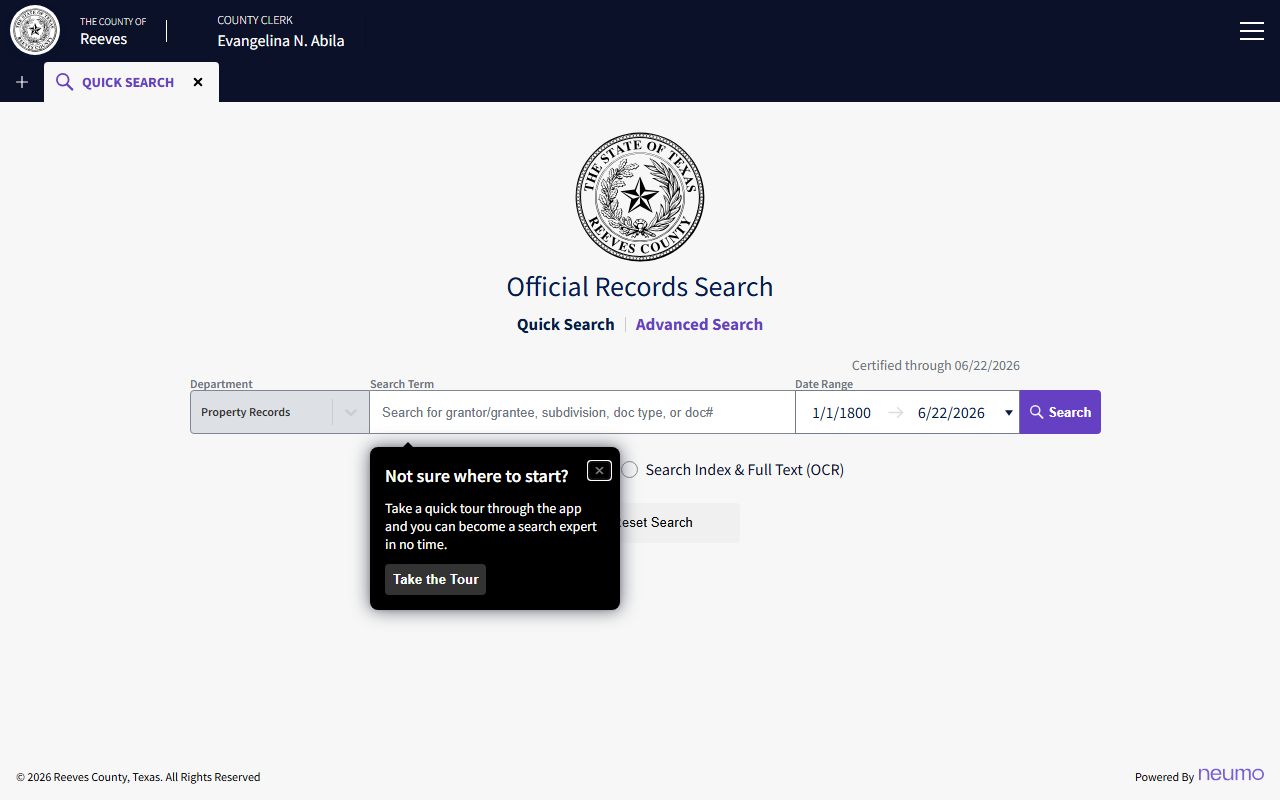
Reeves County has a local official public record search at reeves.tx.publicsearch.us. The visible quick-search interface lets users enter search text and choose between Search Index Only and Search Index & Full Text OCR. Texas also offers re:SearchTX, a statewide trial-court portal. Its account page shows a Basic Free tier, with Premium and Pro paid tiers for broader tools such as advanced search.
- Start with the person's name and the booking charge from the Reeves County jail PDF.
- Search the Reeves County public record portal by name, case term, or document text.
- Search re:SearchTX when a statewide trial-court search is needed.
- Compare the arrest charge with the filed court charge, because wording can change.
- Request official copies from the District Clerk or County Clerk when a portal result is not enough.
The Reeves County public search portal is the county-specific screen for official record searching. The screenshot below shows the quick-search layout used for index and full-text searches.
Reeves County Court Search Fields
The local public record portal and re:SearchTX do not work like the jail roster. The court portals are case and document search tools. A name search may find a case, but a case number, document text, or docket term can be more precise once the case is opened. re:SearchTX requires an account for live searching, while the local portal's visible quick search has separate search-scope choices.
| Portal | Field or Option | Type | Notes |
|---|---|---|---|
| Reeves public search | Search text | Text | Enter a name, case term, or document text depending on scope. |
| Reeves public search | Search Index Only | Selection | Searches indexed information; multiple words may search individually. |
| Reeves public search | Search Index & Full Text OCR | Selection | Searches document contents as well as indexed information. |
| re:SearchTX | Account login | Account | A public user needs an account for live searching. |
| re:SearchTX | Advanced Search | Feature | Advanced tools are tied to account tier. |
Charges After Reeves County Arrest
The path from arrest to court record can include more than one charging document. A complaint may begin the case or support probable cause. An information is a prosecutor-filed charging document often used when indictment is not required or has been waived in the proper setting. An indictment is returned by a grand jury and is most often associated with felony prosecution. Reeves County felony criminal records are tied to the District Clerk, while prosecutor filing decisions involve the 143rd District Attorney for district-level criminal prosecution.
| Document | Who Uses It | What It Does |
|---|---|---|
| Complaint | Officer, prosecutor, or complainant depending on case type | States an accusation and may support early court action. |
| Information | Prosecutor | Files a formal charge without a grand-jury indictment where allowed. |
| Indictment | Grand jury | Returns a felony charge for district court prosecution. |
Reeves County Charge Status
Charge status can change after a jail arrest. The prosecutor may file a different offense than the jail booking label, amend the level, reduce a charge, add a charge, dismiss a charge, or present a case to a grand jury. The jail PDF also uses custody and charge-status words that do not equal final court disposition, such as Bail Set, Magistrate, Hold Over, Probation, Sentenced, and Time Served. A court record is the better source for filed charge status and case outcome.
| Status | What It Means |
|---|---|
| Pending | The charge or case is active and no final disposition is shown. |
| Amended | The charge wording, level, or count changed after filing. |
| Reduced | The filed accusation moved to a lower offense or level. |
| Dismissed | The court record shows the charge was dropped in that case. |
| Convicted | A plea or verdict resulted in a conviction and sentence or penalty. |
Bond Records After Reeves Arrest
Bond information starts in the jail record, but the court record may show bond conditions, changes, revocation, failures to appear, or protective conditions. Texas Code of Criminal Procedure Chapter 17 governs bail and bond. The Reeves roster listed terms such as Bail Set, Magistrate, Hold Place, Hold Over, Sentenced, Time Served, and Temp Release. A dollar amount on the jail PDF does not prove the person can be released, because another hold, warrant, family-violence condition, sentence, or transfer status can block release.
| Bond Type | How It Works |
|---|---|
| Cash bond | Money paid directly if accepted by the court or jail authority. |
| Surety bond | A licensed bail bond company posts the bond for a fee. |
| PR bond | Release based on a promise to appear and comply with conditions. |
| No-bond or hold | Release may be blocked by the charge, warrant, sentence, or another agency. |
Warrants in Reeves County Court Records
No official Reeves County active-warrant search portal was located in the inspected research. The Sheriff's Office page lists the main phone number, (432) 445-4901, and a Crime Tips or Criminal Investigation Division number, (432) 287-0321, but the tips line is not a public warrant verification guarantee. The jail roster can show indirect clues such as "MISC OUT OF COUNTY WARRANT," "Hold Place," or other hold terms, yet it is not a warrant database.
Court records may show bench warrants, failure-to-appear events, warrant returns, or bond forfeiture activity if those events are docketed. Because warrant information can lead to arrest, the safest verification path is the issuing court, counsel, or the Sheriff's Office. A search in the Reeves public portal or re:SearchTX can help locate the case, but it should not be treated as permission to ignore an unresolved warrant.
Charges vs Convictions
A charge after a Reeves County arrest is an accusation. A conviction is a final result based on a plea, verdict, or other qualifying disposition. The distinction matters for employment, housing, licensing, immigration, and personal decisions, but consumer-reporting use must follow FCRA rules. The public court record may show both the charge history and the final disposition, while the jail roster may only show booking or custody labels.
| Point | Charge | Conviction |
|---|---|---|
| Stage | Accusation filed or listed after arrest | Final result from plea, verdict, or judgment |
| Proof | Probable cause or charging decision | Resolved under criminal court standards |
| Record source | Jail roster and court filing | Judgment, docket, or disposition record |
| Can change | May be amended, reduced, or dismissed | May be appealed or affected by later orders |
Sealed and Expunged Arrest Records
Texas Code of Criminal Procedure Chapter 55 governs expunction of eligible criminal records. Expunction is different from nondisclosure or sealing. Expunction can destroy or erase eligible arrest records in the legal sense, while nondisclosure limits public access to records that still exist. The right remedy depends on the charge, disposition, timing, prior record, and court order. A person should not assume a dismissal, no-bill, or time-served entry automatically removes all public traces from every database.
| Point | Nondisclosure or Sealing | Expunction |
|---|---|---|
| Public visibility | Limits public access when an order applies | Treats eligible records as removed or destroyed under the order |
| Record existence | Records may still exist for limited users | Records are erased or destroyed as ordered |
| Eligibility | Depends on Texas statute and case outcome | Depends on Chapter 55 and specific facts |
| Best source | Court order and clerk record | Court order and clerk record |
Restricted Reeves County Court Records
Some records after arrest may be limited, delayed, or withheld. Juvenile records, sealed files, expunged cases, sensitive victim information, and active law-enforcement or prosecution material may not appear in the same way as ordinary public cases. Texas Government Code Section 552.108 allows law-enforcement and prosecutor exceptions in specified situations, while subsection 552.108(c) preserves access to basic information about an arrested person, an arrest, or a crime. That balance is why a jail record, court record, and public-information request can produce different levels of detail.
Important: Court records after arrest can change quickly. Verify official copies with the District Clerk, County Clerk, or issuing court.
Reeves County Prosecutor Records
The 143rd District Attorney handles district-level criminal prosecution for Reeves County, and the official county page lists the office phone as 432-251-0456. The County Attorney page identifies Alva Alvarez as County Attorney and lists rca@reevescounty.org, with Assistant County Attorney and Investigator Randy Reynolds at 432-445-5480. Prosecutor pages are useful for understanding filing responsibility, but court records and official copies still route through the correct clerk. Attorney filings in Texas use eFileTexas, and the District Clerk page says official filings cannot be accepted by fax or email.